
Every cook eventually faces the scaling problem: the recipe serves four, but eight people are coming. Or you want a small batch of cookies, not forty. Halving and doubling sounds like simple arithmetic — and for many ingredients it is — but seasonings, leaveners, liquids, cooking times, and pan sizes don’t all scale in straight lines. Get the math right and the adjustments right, and scaled recipes come out as good as the original.
The easiest way to handle the math is to let a tool do it: our free Recipe Scaler takes any recipe and recalculates every ingredient for your target servings — you can also try it right on the homepage. The guidance below covers the judgment calls no calculator can make for you.
The Basic Math
Scaling is multiplication. Decide your scaling factor: desired servings divided by original servings. Doubling a 4-serving recipe to serve 8 means a factor of 2; halving it to serve 2 means a factor of 0.5. Multiply every ingredient by that factor. Our Recipe Scaler tool on the homepage does exactly this instantly — enter the original servings and your target, and every quantity updates.
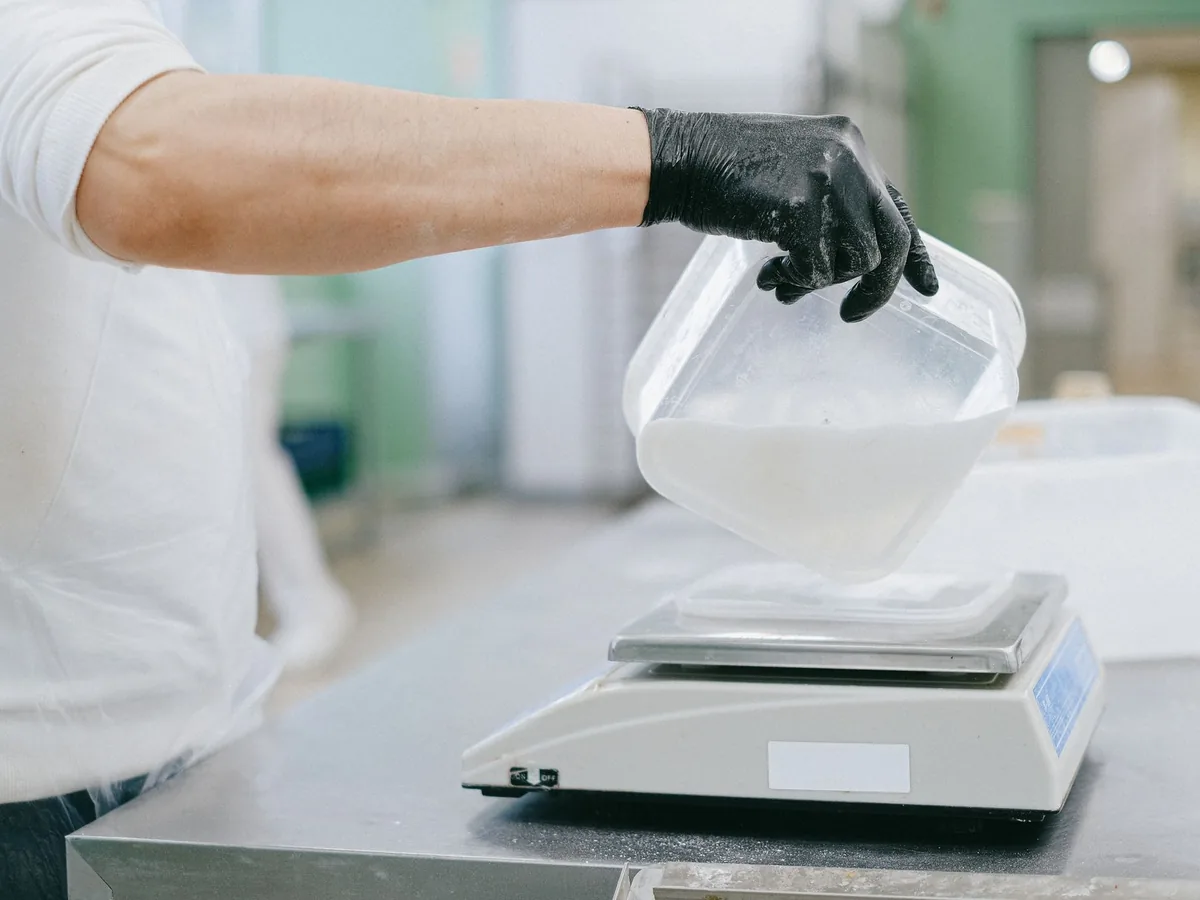
For weight measurements, a kitchen scale makes scaling painless and precise — multiplying 125 grams by 1.5 is far more reliable than scaling “1 cup plus 2 tablespoons.” If you measure by volume, our guide to measuring cups vs. measuring spoons helps you convert scaled amounts accurately (for example, knowing that 0.5 tablespoon is 1½ teaspoons matters when a doubled recipe calls for 3 tablespoons of something).
What Scales Linearly (Just Multiply)
Most core ingredients scale in direct proportion: flour, sugar, butter, oil, meat, vegetables, grains, water, stock, and milk. If the recipe works at 4 servings, twice as much flour and twice as much chicken at 8 servings is exactly right. These are the ingredients the Recipe Scaler handles perfectly — the math needs no judgment.
What Doesn’t Scale Linearly (Adjust with Judgment)
Seasonings and spices. Salt, pepper, chili, and strong spices don’t always need full scaling — doubling salt can easily overshoot. Scale them by about 75% of your factor, taste, and adjust. It’s always easier to add more than to fix too much.
Leaveners (baking powder, baking soda, yeast). These follow chemistry, not arithmetic. When doubling baked goods, increase leaveners by about 1.5x rather than 2x — full doubling often produces a soapy taste or a rise-and-collapse. When halving, keep the full small amount if it drops below ¼ teaspoon; tiny quantities are hard to reduce meaningfully.
Eggs. You can’t easily use half an egg — but you can. Beat the egg, then measure out half by volume (about 1½ tablespoons). For doubling, whole eggs are fine. For awkward factors like 1.5x, the beaten-egg trick keeps ratios exact.
Alcohol, extracts, and potent flavorings. Vanilla, almond extract, and wine or spirits scale like spices: go conservative (around 75%) and adjust. Vanilla in particular can turn bitter in excess.
Thickeners. Cornstarch, flour, and gelatin scale roughly linearly, but large batches of soups and sauces sometimes need slightly less than full scaling — start at 75–80%, then add more if needed.
Comparison: Scaling Rules by Ingredient Type
| Ingredient Type | Scaling Rule | Example |
|---|---|---|
| Flour, sugar, grains, meat, vegetables | Multiply by full factor | Double everything |
| Salt, pepper, chili, spices | ~75% of factor, then taste | Doubling: use 1.5x salt |
| Baking powder / soda | ~1.5x when doubling; don’t go below ¼ tsp when halving | Doubled cake: 1.5x leavener |
| Yeast | Scale gently; time matters more than amount | Doubled dough: 1.5x yeast, watch the rise |
| Eggs | Whole eggs fine for doubling; beat-and-measure for halves | Halved recipe: ½ beaten egg |
| Vanilla, extracts, alcohol | ~75% of factor | Doubled: 1.5x vanilla |
| Oil / butter for sautéing | Doesn’t need full scaling | Doubled stir-fry: 1.25–1.5x oil |
| Water for cooking pasta/rice | Scale with the grain, generously | Double the rice, use a bigger pot |
Pan Size and Equipment Adjustments
This is where most scaling attempts actually fail — not the ingredients, but the vessel. A doubled cake batter in the original pan overflows or bakes raw in the middle; a halved stew in a huge pot evaporates too fast.
- Baked goods: match pan volume to batter volume. Doubling a 9-inch cake? Use two 9-inch pans, or one larger pan — and expect timing changes.
- Stovetop cooking: use a wider or larger pan so food still sits in a proper layer. Crowded pans steam instead of sear.
- Roasting: give everything space on the sheet pan; use two pans rather than piling one high.
- Liquids: bigger pot, always — soups and stocks need headroom to simmer without boiling over.
Timing Adjustments
Scaled recipes rarely cook in the original time. The rules of thumb:
- Larger quantities take longer, but not proportionally. A doubled casserole might need 15–25% more time, not double.
- Thinner layers cook faster. A halved recipe in the same pan spreads thinner and can finish early — start checking sooner.
- Oven temperature usually stays the same. Adjust time, not heat — with one exception: very large roasts or deep dishes sometimes benefit from a slightly lower temperature and longer time for even cooking.
- Trust doneness cues over the clock. Internal temperature, color, texture, and the toothpick test beat any timer when quantities change.
Pros and Cons of Scaling
Pros: cook once for a crowd or for the freezer; test recipes in small batches before committing; adapt any recipe to your household size; batch cooking saves time and money.
Cons: requires judgment on seasonings and leaveners; may need different equipment; timing becomes approximate; very large scaling (4x and beyond) is better done as multiple batches.
Use Cases
- Dinner party: scaling a 4-serving main to 10 — use the Recipe Scaler for the math, a bigger pan, and the 75% rule on salt and spices.
- Small household: halving a family recipe — the beaten-egg trick and careful leavener minimums keep it balanced.
- Meal prep: doubling soups and stews for the freezer — they scale beautifully; portion and freeze the surplus.
- Baking for a bake sale: doubling cookie or cake recipes — scale flour and sugar fully, leaveners at 1.5x, and bake in batches for even results.
Care and Maintenance: Keeping Scaled Recipes Reliable
Write down what worked. When you scale a recipe successfully, note the factor, any seasoning adjustments, the pan you used, and the actual cooking time — future you will thank present you. Keep a conversion cheat sheet inside a cabinet door: common halvings (⅓ cup → 2 tbsp + 2 tsp; ¼ cup → 2 tbsp) save repeated math. And recalibrate your oven with a thermometer before big baking projects, since scaled bakes are less forgiving of temperature errors.
Safety Considerations
Scaling up means more food in the temperature danger zone if you’re careless. Cool large batches quickly — divide into shallow containers and refrigerate within two hours. When scaling down, food can overcook or dry out faster, so check early. For meat, always verify doneness with a thermometer rather than trusting scaled timing: poultry to 165°F (74°C), ground meats to 160°F (71°C). Reheat scaled-up leftovers until steaming throughout.
Common Mistakes
- Doubling the salt. The most common scaling error. Season at 75%, taste, adjust.
- Doubling leaveners fully. Soapy, collapsed bakes follow. Use ~1.5x.
- Using the original pan. Batter volume and pan volume must match, or texture suffers.
- Scaling the time proportionally. Double the food does not mean double the time — check doneness cues early.
- Eyeballing scaled volume measurements. A scale eliminates the compounding error of scaled cups and spoons.
FAQ
Can I just double every ingredient?
For most ingredients, yes — flour, sugar, meat, vegetables, and liquids scale directly. Seasonings, leaveners, eggs, and potent flavorings need the judgment adjustments above.
How do I halve a recipe that calls for 1 egg?
Beat the egg in a small bowl and use half (about 1½ tablespoons). The rest can go into scrambled eggs or another dish.
Does cooking time double when I double a recipe?
No. Larger quantities need more time, but far less than proportional — typically 15–25% more for doubled casseroles and bakes. Start checking early and trust doneness cues.
Should I change the oven temperature when scaling?
Usually keep the same temperature and adjust time instead. Only for very large or deep items should you consider lowering the heat slightly and extending the time.
What’s the best way to scale a baking recipe?
Weigh everything with a kitchen scale, scale flour/sugar/fat fully, use 1.5x leaveners when doubling, match pan volume to batter, and check for doneness early.
Is there a tool that does the math for me?
Yes — our free Recipe Scaler recalculates every ingredient for any serving size, and it’s also embedded on the homepage. It handles the arithmetic; the tips in this guide handle the judgment calls.
Conclusion
Scaling recipes is mostly simple multiplication plus a short list of exceptions: seasonings at three-quarters, leaveners at one-and-a-half when doubling, the right pan for the volume, and doneness cues instead of blind timing. Master those, and any recipe bends to fit your table.
Start with the easy part — run your next recipe through the free Recipe Scaler on the homepage or the full food tools page and let it handle the arithmetic. Pair it with a kitchen scale for precise weights and a quick refresher on measuring cups vs. spoons for accurate volumes, and you’ll never second-guess a scaled recipe again.