
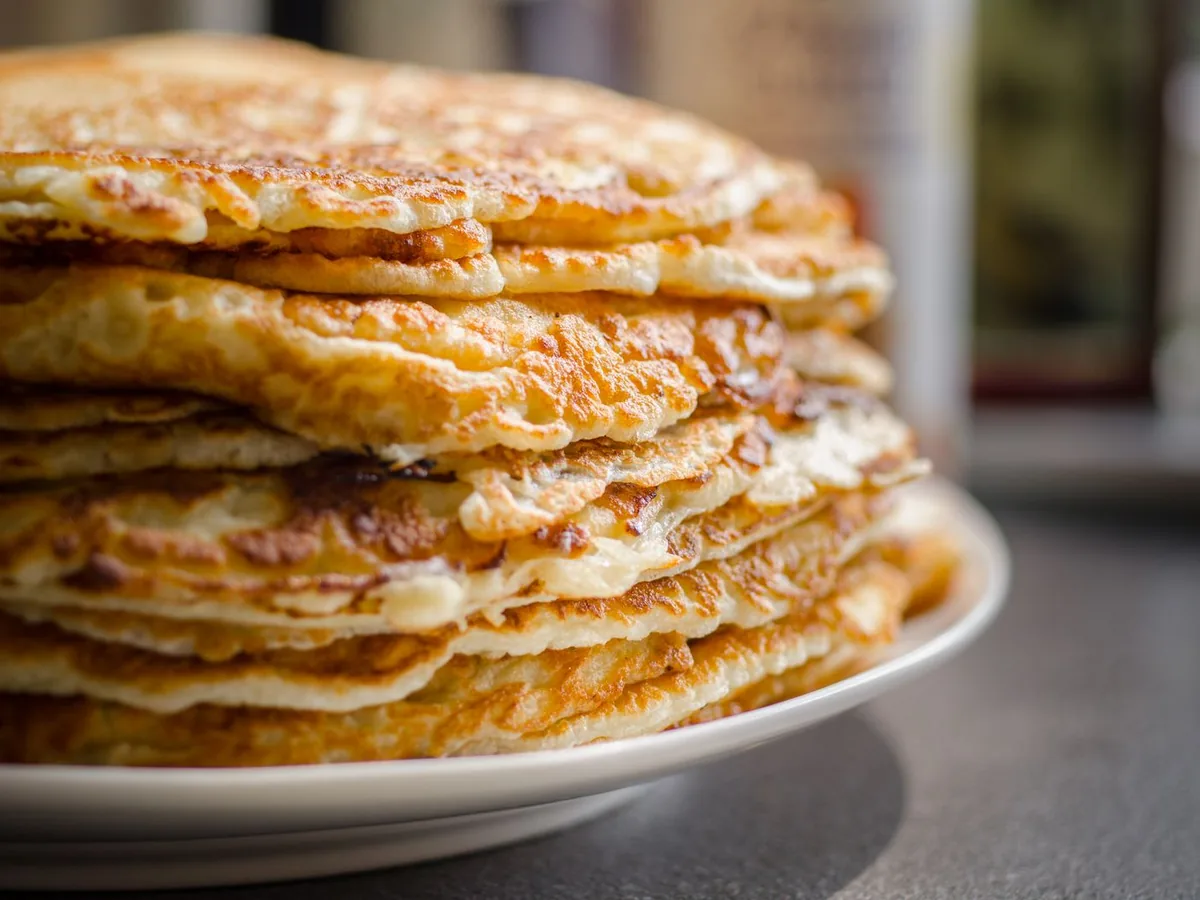
If you’ve only ever made pancakes from a box mix, this recipe will change your weekends. Homemade pancakes are barely more work — flour, sugar, baking powder, milk, egg, butter — but the results are in another league: tall, fluffy, golden-brown, with crisp edges and a tender crumb that box mix simply can’t deliver.
This is a true beginner’s recipe: one bowl for dry ingredients, one for wet, a few gentle stirs, and a hot griddle. No special equipment, no tricky technique — just five small secrets (below) that guarantee fluffy pancakes instead of flat, rubbery ones.
Prep: 10 minutes | Cook: 15 minutes | Total: 25 minutes | Servings: 4 (makes about 8 pancakes)
Homemade Pancakes for Beginners
Fluffy homemade pancakes for beginners — a simple buttermilk batter with 5 secrets for tall, golden pancakes. Ready in 25 minutes.
Ingredients
- 2 cups all-purpose flour
- 2 tablespoons granulated sugar
- 1 tablespoon baking powder
- 1/2 teaspoon baking soda
- 1/2 teaspoon kosher salt
- 1 1/2 cups buttermilk, shaken
- 2 large eggs, room temperature
- 1/4 cup unsalted butter, melted and slightly cooled, plus more for the griddle
- 1 teaspoon vanilla extract
- Maple syrup, for serving
Instructions
- Mix the dry ingredients: Whisk the flour, sugar, baking powder, baking soda, and salt in a large bowl.
- Mix the wet ingredients: Whisk the buttermilk, eggs, melted butter, and vanilla until smooth.
- Combine gently: Pour wet into dry and stir just until combined, 10–12 strokes. Lumps are fine.
- Rest the batter: Rest 5 minutes without stirring; the batter will thicken slightly.
- Heat the griddle: Heat a griddle or skillet over medium heat until a water drop sizzles. Lightly grease with butter.
- Cook the first side: Scoop 1/4-cup portions onto the griddle. Cook 2–3 minutes until bubbles appear and edges look set.
- Flip once: Flip and cook 1–2 minutes more until golden brown.
- Serve: Keep warm in a 200°F (95°C) oven while cooking the rest. Serve hot with maple syrup.
Recipe Notes
Keeps 3 days refrigerated with parchment between layers. Freezes up to 2 months; reheat from frozen in the toaster. Batter doubles cleanly for a crowd.
Why this recipe works
Fluffy pancakes are chemistry, not luck. Baking powder provides the lift — and this recipe uses a full tablespoon, plus the batter rests for 5 minutes so the leavening activates before the pancakes hit the heat. Buttermilk (or milk + vinegar) adds acidity, which reacts with the baking powder for extra rise and gives the crumb its characteristic tang.
The most important rule: mix until just combined, lumps and all. Overmixing develops gluten, and gluten makes pancakes tough and flat instead of tender and tall. Melted butter in the batter adds richness and helps the edges crisp, while cooking on medium (not high) heat gives the centers time to cook through before the outsides burn.
Ingredients
- 2 cups all-purpose flour — spooned into the cup and leveled; packing the flour is the most common measuring mistake.
- 2 tablespoons granulated sugar — just enough for golden browning and a hint of sweetness.
- 1 tablespoon baking powder — make sure it’s fresh (check the date); old baking powder is the top cause of flat pancakes.
- 1/2 teaspoon baking soda — partners with the acidic buttermilk for extra lift.
- 1/2 teaspoon kosher salt — balances the sweetness and sharpens flavor.
- 1 1/2 cups buttermilk, shaken — the acid that makes these tall and tender. (No buttermilk? See substitutions.)
- 2 large eggs, room temperature — bind the batter and add richness; room-temp eggs mix more evenly.
- 1/4 cup unsalted butter, melted and slightly cooled, plus more for the griddle — richness and crisp edges.
- 1 teaspoon vanilla extract — warm background flavor.
- Maple syrup, for serving — the real stuff if you can; it matters.
Substitutions
- No buttermilk: Add 1 1/2 tablespoons of white vinegar or lemon juice to 1 1/2 cups of regular milk; let stand 5 minutes until slightly curdled. It works remarkably well.
- Dairy-free: Use oat or almond milk + vinegar as above, and melted coconut oil or vegan butter instead of butter.
- Gluten-free: A 1:1 gluten-free flour blend works; the batter may need an extra minute of resting.
- Whole wheat: Swap up to half the flour for white whole wheat — expect slightly denser pancakes.
- Add-ins: Fold in 3/4 cup of blueberries, chocolate chips, or diced banana after mixing. Add to individual pancakes on the griddle for the prettiest results.
- Flavored: Add 1/2 teaspoon cinnamon, or lemon zest for lemon pancakes.
Equipment
A large mixing bowl, a whisk, a measuring-cup set, and a griddle or large nonstick/stainless skillet. A 1/4-cup measure or ladle keeps the pancakes uniformly sized. Accurate measuring matters more in pancakes than in most stovetop cooking — our guide to measuring cups vs. measuring spoons explains the spoon-and-level technique, and a digital kitchen scale is even better. For the full starter kit, see essential baking tools for beginners.
Instructions
- Mix the dry ingredients. Whisk the flour, sugar, baking powder, baking soda, and salt together in a large bowl.
- Mix the wet ingredients. In a second bowl or large measuring cup, whisk the buttermilk, eggs, melted butter, and vanilla until smooth.
- Combine — gently. Pour the wet ingredients into the dry. Stir with a wooden spoon or spatula just until combined — 10 to 12 strokes. Lumps are fine; lumps are good. Stop the moment you don’t see dry flour.
- Rest the batter. Let the batter rest for 5 minutes. It will thicken slightly as the flour hydrates and the leavening activates. Don’t stir it again.
- Heat the griddle. Heat a griddle or large skillet over medium heat. It’s ready when a drop of water sizzles and evaporates within a couple of seconds. Lightly grease with butter.
- Cook the first side. Scoop 1/4-cup portions of batter onto the griddle, leaving space between them. Cook 2–3 minutes, until bubbles appear on the surface and the edges look set.
- Flip once. Flip and cook 1–2 minutes more until golden brown. Only flip once — repeated flipping deflates pancakes.
- Serve. Keep finished pancakes warm in a 200°F (95°C) oven while you cook the rest. Serve hot with maple syrup, butter, and your favorite toppings.
Recipe scaling notes
Pancake batter doubles and triples cleanly — the ratios are simple. For a crowd, keep cooked pancakes warm in a low oven (200°F / 95°C) on a sheet pan; they hold beautifully for 30 minutes. Our Recipe Scaler does the multiplication for any serving count, and How to Scale Recipes Without Ruining Them covers batter-based scaling in general.
Storage and reheating
Refrigerate leftover pancakes in an airtight container or zip-top bag for up to 3 days, with parchment between layers so they don’t stick. Reheat in the toaster (best — restores crisp edges), a 350°F (175°C) oven for 5 minutes, or the microwave for 20 seconds per pancake (softest result).
Freezing
Pancakes are freezer champions. Cool completely, stack with parchment squares between them, and freeze in a zip-top bag for up to 2 months. Reheat straight from frozen in the toaster — they come out nearly as good as fresh. Make a double batch on Sunday and you’ve got instant weekday breakfasts.
Common mistakes and troubleshooting
- Flat pancakes: Old baking powder, overmixed batter, or no rest. Check the date on your leavening, stir minimally, and rest the batter.
- Tough and rubbery: Overmixed — the number-one beginner mistake. Count your strokes and stop at 12.
- Burnt outside, raw inside: Heat too high. Medium heat is the sweet spot; the first pancake is always the test.
- Sticking: Griddle wasn’t hot enough before the butter went on, or not enough fat. Water-drop test, then butter.
- Uneven sizes: Eyeballing the pour. A 1/4-cup measure gives you diner-perfect uniformity.
- Pale and sad: Not enough heat, or the griddle was crowded and steamed. Give each pancake space and let the griddle recover between batches.
Frequently asked questions
Why are my pancakes flat? The usual suspects, in order: expired baking powder, overmixed batter, or skipping the rest. Fresh leavening + gentle mixing + 5-minute rest = tall pancakes.
Should pancake batter be lumpy? Yes! Small lumps are exactly right. A perfectly smooth batter means you overmixed, and overmixed batter makes tough pancakes.
Can I make the batter ahead? You can mix the dry ingredients days ahead (store airtight). Mixed batter is best used within 30 minutes — the baking powder loses power as it sits. For longer prep, see the freezing instructions instead.
What’s the best pan for pancakes? A heavy griddle or large nonstick skillet over medium heat. Cast iron works beautifully once properly heated. Whatever you use, keep the heat at medium — patience beats temperature.
How do I know when to flip? Bubbles on the surface that pop and stay open, plus edges that look set and matte rather than wet and shiny. That’s your cue — usually 2–3 minutes.
Can I keep pancakes warm for a crowd? Yes — a 200°F (95°C) oven on a sheet pan holds them perfectly for up to 30 minutes without drying out. Don’t stack them high or the bottoms steam.
Nutrition
One serving (2 pancakes with 1 tablespoon of maple syrup) contains an estimated 350 calories, 9g protein, 58g carbohydrates, and 10g fat. These are estimates only, based on standard ingredient data — actual values vary with pancake size, butter amount, and toppings. This is a general guide, not medical advice.
Weekend mornings, upgraded
Once you’ve made fluffy homemade pancakes from scratch, the box mix will gather dust. It’s the same 25 minutes, but the results taste like a diner breakfast made just for you. For another from-scratch morning win, our Simple Homemade Pizza for Beginners brings the same dough confidence to Friday nights.