
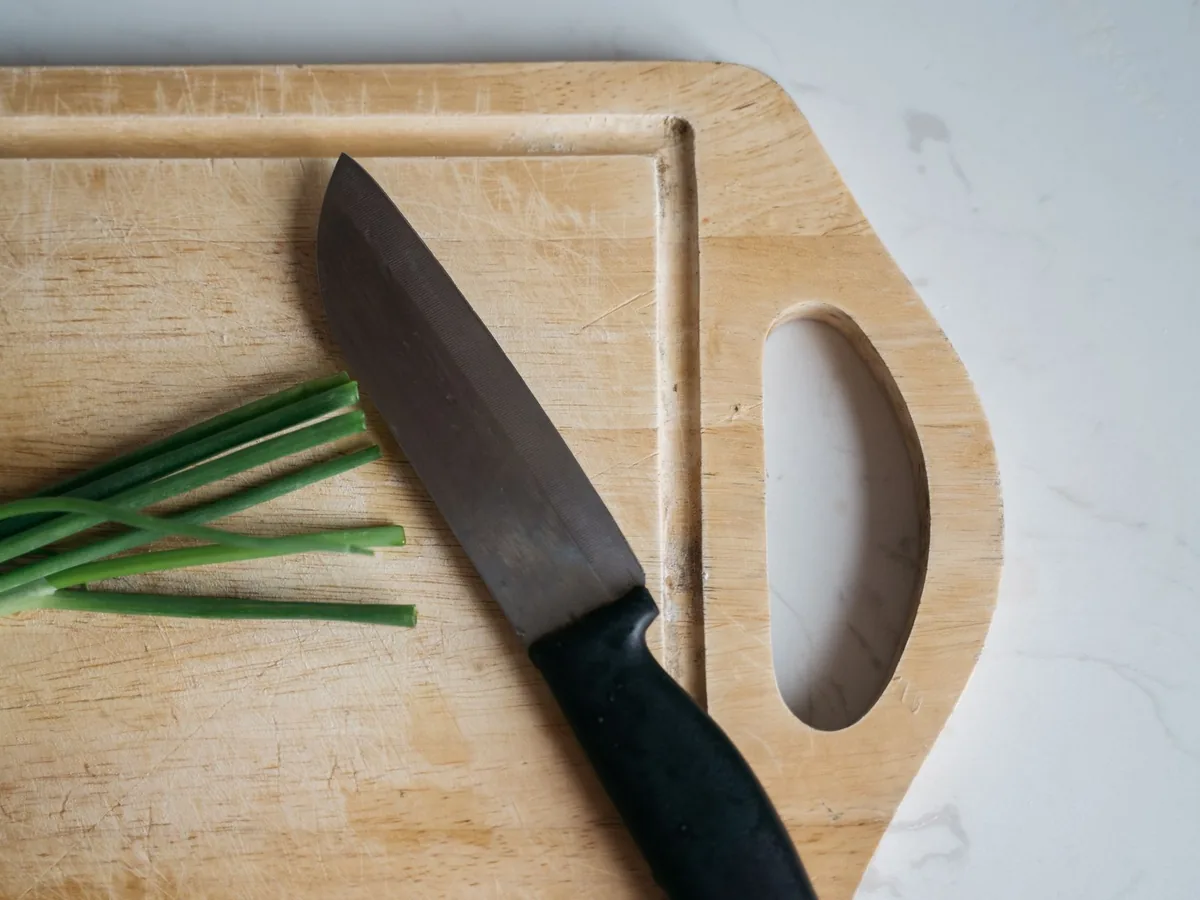
Your cutting board is the unsung partner of your knife — the surface where nearly all prep happens. Choose well and your chef’s knife stays sharper longer, your vegetables stop sliding around, and chopping feels calm instead of chaotic. Choose poorly and you’ll dull good edges, fight a board that slips across the counter, and wonder why prep feels like a chore.
The good news: this is one of the simplest buying decisions in the kitchen. There are really only a few materials worth considering, a couple of sizes that work for most people, and a short list of things to avoid. Here’s everything you need to know.
The Materials That Matter
Wood
The classic for good reason. Wood is naturally kind to knife edges, has a pleasant heft that stays put, and — with basic care — lasts for years. Maple is the workhorse: hard, tight-grained, and affordable. Walnut is darker, slightly softer, and beautiful. Cherry falls somewhere between.
Within wooden boards you’ll see two constructions:
- Edge-grain: strips of wood glued edge-to-edge, showing long grain lines. Affordable, durable, and the most common.
- End-grain: the ends of the wood face up, like a butcher block. The fibers “give” under the knife and then close back up, which is exceptionally gentle on edges and hides cut marks. Heavier and pricier, but the gold standard for serious chopping.
Wood’s trade-off is maintenance: hand wash only, dry promptly, and oil occasionally with food-grade mineral oil to prevent drying and cracking.
Plastic (HDPE)
Lightweight, inexpensive, dishwasher-safe, and available in every size. Plastic boards are the practical choice for raw meat and poultry — you can sanitize them in the dishwasher without worry, and many cooks keep a dedicated plastic board just for proteins. They’re gentler on knives than glass or stone, though slightly harder on edges than wood.
The downside: plastic scars. Deep knife grooves trap bacteria and can’t be sanded out like wood, so plastic boards need replacing once they’re heavily scored.
Bamboo
Harder than most woods, lightweight, and marketed as eco-friendly since bamboo grows fast. It looks great and resists moisture well. The catch: bamboo’s hardness (plus the silica naturally present in it) makes it tougher on knife edges than wood. It’s a fine board, but your knives will need sharpening a bit more often.
Composite (wood fiber / resin)
Boards made from compressed wood fiber or paper composite offer a middle ground: dishwasher-safe like plastic, denser and more knife-friendly than cheap plastic, and quite durable. They’re a solid upgrade pick if you want low maintenance without going full plastic.
What to Avoid
- Glass and marble/granite boards. They look sleek and wipe clean, but they’re brutal on knife edges — every cut is steel against stone. Use them as serving platters, never as cutting surfaces.
- Boards that are too small. An 8-by-10-inch board might look tidy, but food piles up and falls off. Bigger is almost always better.
- Warped or cracked boards. A board that rocks or has deep cracks harbors bacteria and wobbles dangerously. Replace it.
Head-to-Head Comparison
| Wood (edge-grain) | Wood (end-grain) | Plastic (HDPE) | Bamboo | Glass/Stone | |
|---|---|---|---|---|---|
| Kindness to knives | Excellent | Best | Good | Fair | Terrible — avoid |
| Maintenance | Hand wash + occasional oiling | Hand wash + regular oiling | Dishwasher-safe | Hand wash | Dishwasher-safe |
| Durability | Years; can be sanded and re-oiled | Decades with care | Replace when deeply grooved | Years | Won’t wear out (your knives will) |
| Weight/stability | Heavy, stays put | Very heavy, rock solid | Light; can slip (use a damp towel) | Light-medium | Heavy |
| Best for | Everyday all-purpose chopping | Serious prep, prized knives | Raw meat, poultry, fish | Low-maintenance everyday use | Serving only |
| Cost | Moderate | Higher | Low | Low-moderate | Low-moderate |
Choosing the Right Size
Size matters more than most buyers expect. A cramped board means chopped onions cascading onto the counter and nowhere to rest the knife.
- Everyday main board: at least 12 × 18 inches (about 30 × 45 cm). This gives you room to chop and to park finished piles to the side.
- Small secondary board: an 8 × 12 inch board is handy for quick jobs — slicing a lemon, mincing garlic — when you don’t want to haul out the big one.
- Thickness: around 1 inch or more for wood (resists warping); plastic can be thinner but shouldn’t flex.
If your counter space is tight, one large board beats two small ones.
Features Worth Having
- Juice groove: a channel around the edge catches runoff from roasted meats and juicy fruits. Essential if you carve roasts on your board — as when prepping oven-roasted potatoes alongside a Sunday roast.
- Reversible design: flat on both sides doubles your workspace (use one side for produce, flip for… well, wash between uses — but it extends the board’s life).
- Handles or finger grooves: make a heavy board easier to lift and carry to the sink.
- Non-slip feet or a damp towel: a board that slides is a safety hazard. Rubber feet help; a damp kitchen towel underneath works on any board.
Care and Maintenance by Material
Wood:
– Hand wash with hot soapy water immediately after use; never soak, and never put it in the dishwasher — water and heat warp and crack wood.
– Dry upright so air circulates on both sides.
– Oil every few weeks (or when the wood looks pale) with food-grade mineral oil — rub it in, let it soak, wipe off the excess. Skip olive or vegetable oils, which can turn rancid.
– Sanitize after raw meat with diluted white vinegar or a mild bleach solution, then rinse and dry.
Plastic:
– Dishwasher-safe — the easiest board to keep sanitary, which is why it’s ideal for raw proteins.
– Replace when knife grooves get deep enough to trap food and resist cleaning.
Bamboo and composite:
– Hand wash bamboo (dishwasher heat can split it); most composite boards tolerate the dishwasher — check the maker’s guidance.
– Bamboo benefits from occasional mineral oil just like wood.
Food Safety: One Board or Two?
Raw meat, poultry, and seafood should never share a cutting surface with ready-to-eat foods unless the board is thoroughly washed and sanitized between uses. The simplest system: one board for raw proteins, one for produce and everything else. Color-coded plastic boards make this effortless, or use your big wooden board for vegetables and a dishwasher-safe plastic one for meat. Either way, wash with hot soapy water between tasks and sanitize after raw proteins.
Safety Basics
- Stabilize the board. A damp towel or non-slip mat underneath prevents the number-one cutting board accident: the board sliding mid-chop.
- Keep it flat. A warped board rocks; replace or resurface it.
- Mind your fingers with the claw grip — curl fingertips under, knuckles guiding the blade.
- Carry heavy boards carefully — end-grain blocks are dense; lift with both hands.
Common Mistakes
- Cutting on glass or stone. The fastest way to destroy a good knife’s edge.
- Buying too small. Measure your counter, then buy the biggest board that fits comfortably.
- Soaking wooden boards. Or worse, dishwashing them. Water is wood’s enemy.
- Oiling with cooking oil. Olive and vegetable oils go rancid; use food-grade mineral oil.
- Using one board for everything without washing. Raw chicken followed by salad on the same unwashed surface is asking for trouble.
- Keeping a deeply grooved plastic board. Once grooves trap debris you can’t clean out, the board is done.
Frequently Asked Questions
Is wood or plastic better for a cutting board?
For most home cooks, the answer is both: a large wooden board for everyday vegetable and general prep (kinder to knives, pleasant to use), plus an inexpensive plastic board dedicated to raw meat and poultry (dishwasher-safe and easy to sanitize).
What size cutting board should I buy?
As large as your counter and sink allow — 12 × 18 inches is the practical minimum for a main board. Small boards cause more mess and frustration than they’re worth as your only board.
How often should I oil a wooden cutting board?
When the wood looks dry or pale — typically every few weeks with regular use. A well-oiled board resists moisture, stains, and cracking.
Can I put a wooden cutting board in the dishwasher?
No. The prolonged hot water and heat warp, crack, and split wood. Hand wash, dry promptly, and your board will last years.
When should I replace a cutting board?
Replace plastic boards when deep grooves won’t come clean; replace wooden boards when they’re warped, cracked through, or too thin from years of resurfacing. A quality end-grain board can last decades.
Are bamboo cutting boards bad for knives?
Not bad, just harder on edges than wood. Bamboo contains silica and is quite hard, so knives need honing and sharpening a little more often. If you love the look and low maintenance, it’s a fair trade.
The Bottom Line
For most kitchens, the winning setup is simple: one large wooden board (edge-grain maple is the value sweet spot; end-grain if you want the best) for everyday prep, plus one dishwasher-safe plastic board reserved for raw proteins. Size up generously, stabilize the board with a damp towel, and pair it with a sharp chef’s knife you’ve learned to choose well — the two tools elevate each other. Take care of the wood with an occasional oiling, retire plastic when it’s scarred, and never let glass near your knives. Do that, and whether you’re breaking down vegetables or carving up a tray of oven-roasted potatoes, your board will be the quiet foundation that makes it all easy.