
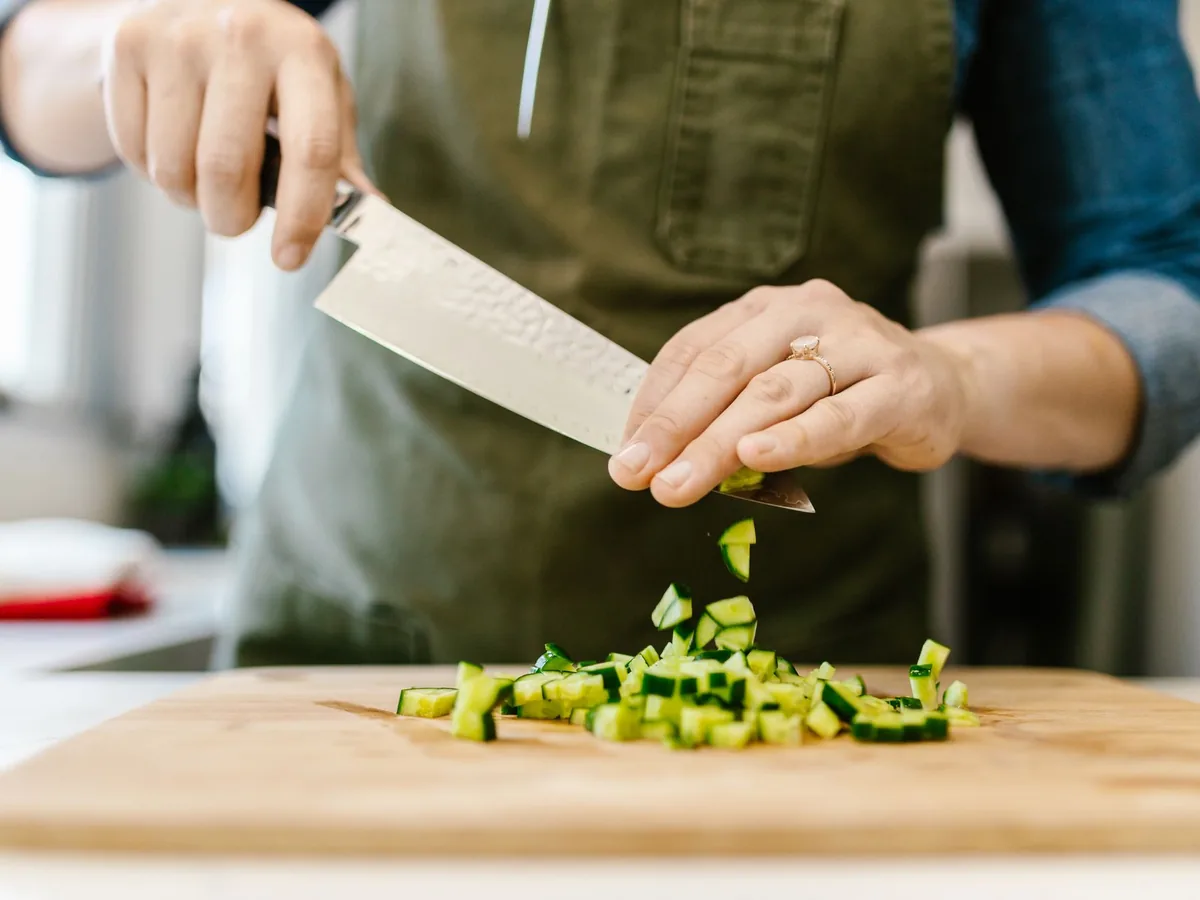
If you buy only one good knife in your life, make it a chef’s knife. This is the workhorse of the kitchen — the blade you’ll reach for to chop onions, slice tomatoes, mince garlic, and break down a whole chicken. A dull, flimsy knife turns cooking into a chore; a sharp, well-balanced one makes prep faster, safer, and honestly more enjoyable.
But walk into any kitchen store (or open any online shop) and the options are overwhelming: 6-inch, 8-inch, 10-inch, German, Japanese, forged, stamped, carbon steel, Damascus. This guide cuts through the noise. You’ll learn exactly what matters when you choose a chef’s knife, what you can safely ignore, and the mistakes that send so many buyers home with the wrong blade.
Start With the Blade Length
Blade length is measured from the tip to the heel (where the blade meets the handle). For most home cooks, an 8-inch (20 cm) blade is the sweet spot. It’s long enough to slice through a butternut squash or a head of cabbage in smooth strokes, yet short enough to stay nimble for mincing herbs.
Here’s how the common sizes compare:
- 6-inch: Great if you have small hands, a tiny kitchen, or a cramped cutting area. It feels like an extension of your hand, but you’ll find yourself “sawing” through larger produce.
- 8-inch: The all-rounder. Enough blade to rock-chop and slice in long strokes, manageable for most people. If you buy one knife, buy this size.
- 10-inch: A favorite of professionals who process large volumes of food. It powers through big jobs but can feel unwieldy and intimidating if you’re not used to it.
If you’re unsure, go with 8 inches. It’s the size most cooking schools teach with, and it suits the widest range of tasks and hand sizes.
Blade Style: German vs. Japanese
Most chef’s knives fall into one of two traditions, and the difference affects how the knife feels and how you cut with it.
| Feature | German-style | Japanese-style (gyuto) |
|---|---|---|
| Blade profile | Deeply curved belly, pointed tip | Flatter profile, gentler curve |
| Weight | Heavier; the knife does some of the work | Lighter and thinner |
| Cutting motion | Rocking (tip stays on the board) | Push-cutting and slicing |
| Edge angle | Wider angle, tougher edge | Narrower angle, keener edge |
| Steel | Softer, more forgiving | Harder, holds sharpness longer but can chip |
| Best for | Cooks who rock-chop; heavy-duty tasks | Precise slicing; cooks who push-cut |
Neither style is objectively better — it’s about how you cook. If you chop with a rocking motion, a German-style blade’s curve feels natural. If you slice in straight push cuts, a Japanese-style gyuto glides beautifully. Many beginners find the German style more forgiving, while the Japanese style rewards good technique with remarkable sharpness. Either way, you’ll want a sturdy cutting board to match your knife — a stable, knife-friendly surface makes any blade perform better.
What the Blade Is Made Of
The steel determines how sharp the knife gets, how long it stays sharp, and how much maintenance it demands.
- High-carbon stainless steel: The most common choice for good reason. It resists rust and stains, takes a keen edge, and needs no special care beyond normal washing and drying. Most quality chef’s knives use some version of this.
- Carbon steel: Gets razor sharp and is beloved by enthusiasts, but it reacts with acidic foods, develops a dark patina, and will rust if left wet. Wonderful if you enjoy maintaining your tools; frustrating if you don’t.
- Damascus (pattern-welded) steel: Those beautiful wavy patterns come from layering different steels. The pattern is mostly cosmetic — what matters is the core steel and the heat treatment. Don’t pay extra for looks alone.
For a first serious knife, high-carbon stainless steel is the sensible pick: sharp, low-drama, and forgiving.
Forged vs. Stamped
You’ll see these terms on packaging. Forged blades are shaped from a single piece of heated steel; stamped blades are cut from a flat sheet like a cookie cutter. Forged knives tend to be thicker, heavier, and often have a bolster (the thick collar between blade and handle). Stamped knives are thinner and lighter.
The old rule was “forged is better,” but modern manufacturing has blurred the line — there are excellent stamped knives and mediocre forged ones. Judge the knife in your hand, not the label.
The Handle Matters More Than You Think
You’ll grip this handle thousands of times. It should feel comfortable and secure in your hand, which is why holding a knife before buying — if you can — is so valuable.
- Shape: Western handles are often rounded and contoured; Japanese handles (wa-handles) are typically lighter, octagonal or oval, and can feel wonderfully nimble.
- Material: Wood looks beautiful but needs occasional oiling; durable synthetics and composites handle dishwasher-adjacent abuse and wet hands well.
- Full tang: A tang is the part of the blade that extends into the handle. A full tang (metal running the full length and width of the handle, often visible as a strip along the edges) generally gives better balance and durability. It’s a good sign, though not a guarantee of quality.
Pay attention to balance: hold the knife where the blade meets the handle. A well-balanced knife feels neither blade-heavy nor handle-heavy — it should feel like a natural extension of your arm, not a hammer or a wand.
Pros and Cons: What a Chef’s Knife Does Best (and Doesn’t)
Where it shines:
– Chopping, dicing, and mincing vegetables and herbs
– Slicing meat and fish
– Smashing garlic cloves with the flat of the blade
– Scooping chopped food off the board (use the spine, not the edge)
Where it doesn’t:
– It’s not a bread knife — serrated blades handle crusty loaves better
– It’s not a paring knife — small, in-hand work calls for a smaller blade
– Don’t use it to pry open cans, cut through bones, or hack frozen food; that’s how edges chip
Care and Maintenance
A good knife can last decades with basic care. Here’s the routine that keeps an edge keen:
- Hand wash and dry immediately. Dishwashers are brutal on knives: high heat, harsh detergent, and rattling against other utensils dull edges and can damage handles. A quick wash with soap and water takes seconds.
- Hone regularly. A honing steel doesn’t sharpen — it straightens the microscopic edge back into alignment. A few light strokes before each use keeps the knife cutting well between sharpenings.
- Sharpen when honing stops helping. When the knife slides off a tomato skin instead of biting in, it’s time to sharpen — with a whetstone, a guided sharpener, or a professional service.
- Store it safely. Loose in a drawer, blades bang against everything and dull fast (and surprise your fingers). Use a magnetic wall strip, a knife block, or simple blade guards.
- Cut on the right surface. Wood and quality plastic boards are kind to edges; glass, ceramic, stone, and metal are edge-killers.
For the full routine — washing, honing, sharpening schedules, and storage — see our guide to cleaning and maintaining your kitchen knives.
Safety Basics
A sharp knife is actually safer than a dull one: it goes where you aim it instead of slipping. Still, respect the blade.
- Use the claw grip. Curl your fingertips under, knuckles forward, guiding the food while the flat of the blade rides against your knuckles.
- Keep the tip on the board when rock-chopping; let the curve do the work.
- Never try to catch a falling knife. Step back and let it drop.
- Cut away from your body, and keep your guiding hand’s fingers tucked.
- A stable board is non-negotiable. Put a damp towel under your cutting board so it can’t slide mid-chop.
Common Mistakes to Avoid
- Buying a huge set instead of one great knife. Those 15-piece block sets look like a deal, but you’ll use the chef’s knife for 90% of tasks while the rest gather dust. Start with one excellent chef’s knife, then add a paring knife and a bread knife later.
- Choosing by looks. A dramatic Damascus pattern or a flashy handle means nothing if the knife feels wrong in your hand.
- Going too big (or too small) for your hands. An 8-inch blade suits most people, but if it feels like a sword, a 6-inch you’ll actually control beats an 8-inch you’re afraid of.
- Putting it in the dishwasher. The single fastest way to ruin a good knife.
- Cutting on glass or stone. Your edge will thank you for switching to wood or plastic.
- Waiting too long to sharpen. If you’re muscling through an onion, the knife is telling you something. Hone often, sharpen when needed.
Frequently Asked Questions
How much should I expect to spend on a decent chef’s knife?
Prices vary widely, but there’s a broad middle range where quality jumps noticeably compared with bargain-bin knives, and diminishing returns set in above it. You don’t need the most expensive option — focus on comfort, balance, and steel quality rather than the price tag.
Is an expensive knife worth it for a beginner?
A mid-range knife from a reputable maker is the sweet spot for beginners. Ultra-cheap knives often have poor balance and soft steel that won’t hold an edge; top-tier knives reward skills you may still be building. Buy the best you can comfortably afford in the middle range.
What’s the difference between honing and sharpening?
Honing realigns an edge that’s folded over microscopically — it’s maintenance you can do often. Sharpening actually removes metal to create a new edge — it’s needed less often, when honing no longer restores cutting performance.
Can I put my chef’s knife in the dishwasher?
You can, but you shouldn’t. The heat, detergent, and jostling dull the edge and can damage the handle. Hand washing takes under a minute and dramatically extends the knife’s life.
How do I know when my knife needs sharpening?
Try slicing a ripe tomato or a piece of paper. A sharp knife bites in with light pressure; a dull one slides, tears, or needs force. If honing doesn’t fix it, it’s sharpening time.
Should left-handed cooks buy a special knife?
Most Western-style chef’s knives are ground symmetrically and work fine for either hand. Some Japanese-style knives have single-sided edges designed for right-handed use — if you’re left-handed, check the edge grind or choose a double-bevel knife.
The Bottom Line
Choosing a chef’s knife comes down to fit: an 8-inch blade in high-carbon stainless steel, a handle that feels like it was made for your hand, and a style (German or Japanese) that matches how you cut. Buy one great knife instead of a mediocre set, keep it sharp, and treat your cutting board as its partner — the two work as a team. Learn the simple maintenance routine in our knife care guide, and you’ll be amazed how much more enjoyable prep becomes. Once your knife skills are dialed in, put them to work on something delicious like a big batch of homemade vegetable soup — there’s no better way to break in a new blade.